|
|
Space Astro
|
Info for exoplanet "Paano'sha"
| Scientific (actual) data |
|---|
| Name | TOI-1885 b |
| Planet status | Confirmed |
| Planet mass | 1.6248 |
| Radius | 1.2187 |
| Orbital period | 6.54406 |
| Semi major axis | 0.0728 |
| Orbit eccentricity | 0.04 |
| Discovered | 2024 |
| Updated | 2024-06-26 |
| Publication | Published in a refereed paper |
| Detection type | Primary Transit |
| Mass measurement type | Radial Velocity |
| Radius measurement type | Primary Transit |
| Star name | TOI-1885 |
| Ra | 304.67° |
| Dec | 66.16° |
| Mag v | 12.693 |
| Mag j | 11.282 |
| Mag h | 10.967 |
| Mag k | 10.932 |
| Star distance | 560.901 |
| Star metallicity | 0.03 |
| Star mass | 1.2 |
| Star radius | 1.757 |
| Star sp type | F8IV |
| Star age | 3.7 |
| Star temperature | 6232 |
| Wikipedia article | TOI-1885 b |
Back
| |
| Fictional info (?) |
|---|
| Paano'sha |
| Hot gas giant |
| As seen from TOI-1885, in a frame of reference that rotates with the orbital motion, it appears to rotate only once every two years.
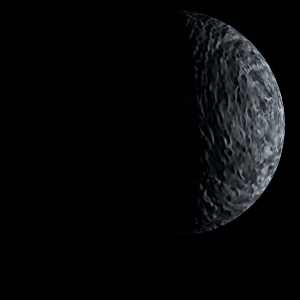
The smooth Borealis basin in the northern hemisphere covers 15 percent of the planet and may be a giant impact feature.
problematic voyage. |
| Atmosphere | Hydrogen chloride | 82% |
| Nitric oxide | 7.6% |
| Ozone | 4.3% |
| Helium | 2.6% |
| Ammonium hydrosulfide (NH4SH) | 1.8% |
| Carbon dioxide | 1.1% |
| 0.015 bar |
| 2.9 × Earth |
 |
| No known satellites |
| Google search for Paano'sha |
|
Website by Joachim Michaelis
|
|
|
|