|
|
Space Astro
|
Info for exoplanet "Aethaton"
| Scientific (actual) data |
|---|
| Name | Kepler-1743 b |
| Planet status | Confirmed |
| Radius | 0.142637 |
| Orbital period | 7.64971 |
| Semi major axis | 0.0822 |
| Inclination | 77.52 |
| Discovered | 2017 |
| Updated | 2024-06-11 |
| Tzero tr | 2454970 |
| Impact parameter | 0.898 |
| Temp calculated | 1144 |
| Publication | Announced on a website |
| Detection type | Primary Transit |
| Radius measurement type | Primary Transit |
| Alternate names | KOI-1316 b, KOI-1316.01 |
| Star name | Kepler-1743 |
| Ra | 290.55° |
| Dec | 48.13° |
| Mag v | 12.06 |
| Mag i | 11.694 |
| Mag j | 10.894 |
| Mag h | 10.606 |
| Mag k | 10.562 |
| Star distance | 538.807 |
| Star metallicity | 0.1973 |
| Star mass | 1 |
| Star radius | 2.0998 |
| Star sp type | G3IV |
| Star age | 5.1 |
| Star temperature | 5624.37 |
| Star alternate names | 10794087, KOI-1316 |
| Wikipedia article | Kepler-1743 b |
Back
| |
| Fictional info (?) |
|---|
| Aethaton |
| Warm planet |
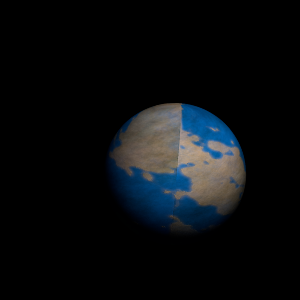
| Its orbital period around Kepler-1743 of 7.6 earth days is the longest of all the planets in its solar system.
As seen from Kepler-1743, in a frame of reference that rotates with the orbital motion, it appears to rotate only once every two years.
The two polar ice caps appear to be made largely of rock.
Its north and south poles, therefore, lie where most other planets have their equators. |
| Atmosphere | Ozone | 62% |
| Hydrogen peroxide | 21% |
| Formaldehyde | 16% |
| Carbon monoxide | 0.0014% |
| Xenon | 0.0013% |
| 0.31 bar |
| 0 × Earth |
 |
| Moon | Tejarnanda | Huge irregular rocky asteroid |
| Farime Sida | Small slightly egg-shaped rocky asteroid |
| Deucesraq Greip | Medium-sized round crater-filled moon |
| Google search for Aethaton |
|
Website by Joachim Michaelis
|
|
|
|