|
|
Space Astro
|
Info for exoplanet "Tomaka Jul"
| Scientific (actual) data |
|---|
| Name | Gaia-5 b |
| Planet status | Confirmed |
| Planet mass | 20.93 |
| Orbital period | 358.57 |
| Orbit eccentricity | 0.641 |
| Inclination | 129.7 |
| Discovered | 2024 |
| Updated | 2024-11-25 |
| Omega | 271.72 |
| Tperi | 2457430 |
| K | 1179.8 |
| Publication | Published in a refereed paper |
| Detection type | Astrometry, Radial Velocity |
| Mass measurement type | Astrometry |
| Star name | Gaia-ASOI-015 |
| Ra | 302.04° |
| Dec | 41.94° |
| Mag v | 14.2433 |
| Star mass | 0.362023 |
| Star alternate names | GAIA DR3 2074815898041643520 |
| Wikipedia article | Gaia-5 b |
Back
| |
| Fictional info (?) |
|---|
| Tomaka Jul |
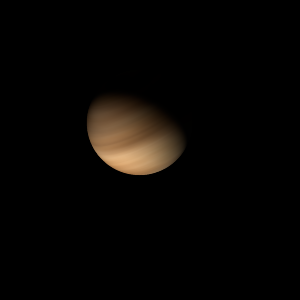
| Huge cold gas giant |
| As seen from Gaia-ASOI-015, in a frame of reference that rotates with the orbital motion, it appears to rotate only once every two years.
The smooth Borealis basin in the northern hemisphere covers 19 percent of the planet and may be a giant impact feature. |
| Atmosphere | Ammonia | 90% |
| Carbon monoxide | 6.4% |
| Oxygen | 3.3% |
| 4 bar |
 |
| No known satellites |
| Google search for Tomaka jul |
|
Website by Joachim Michaelis
|
|
|
|