|
|
Space Astro
|
Info for exoplanet "Gyawamyo-rowa"
| Scientific (actual) data |
|---|
| Name | 109 Psc c |
| Planet status | Confirmed |
| Mass sini | 0.0522 |
| Orbital period | 8.1127 |
| Orbit eccentricity | 0.18 |
| Discovered | 2026 |
| Updated | 2026-07-13 |
| Omega | 109 |
| K | 5.03 |
| Publication | Published in a refereed paper |
| Detection type | Radial Velocity |
| Mass measurement type | Radial Velocity |
| Alternate names | HD 10697 c |
| Star name | 109 Psc |
| Right ascension | 26.23° |
| Declination | 20.08° |
| Mag v | 6.29 |
| Star distance | 32.56 |
| Star metallicity | 0.1 |
| Star mass | 1.13 |
| Star radius | 1.79 |
| Star sp type | G5IV |
| Star age | 6.9 |
| Star temperature | 5600 |
| Star alternate names | HD 10697 |
| Wikipedia article | 109 Psc c |
Back
| |
| Fictional info (?) |
|---|
| Gyawamyo-rowa |
| Cold planet |
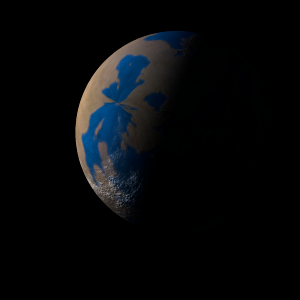
| It is radically different from Earth in other respects. It has the densest atmosphere of the three cold planets, consisting of huge amounts of carbon dioxide.
The nice surface is crowded with small advanced insects, the "Nyagugyu", which feed only by seeking the Tsubapyu. Nyagugyu are closely related to the Behi-guto Su and have wings and vary in size from 27 to 64 cm. The Nyagugyu are able to live at temperatures from 40 to 90°C and even prolonged periods without food which is common near the poles. |
| 1200000000 |
| Atmosphere | Carbon dioxide | 93% |
| Water | 5.9% |
| Methane | 0.34% |
| Oxygen | 0.00093% |
| 12 bar |
 |
| No known satellites |
| Google search for Gyawamyo-rowa |
|
Website by Joachim Michaelis
|
|
|
|